Why Your Jackpot Ticker’s Count-Up Trains Players to Chase Losses
Discover how jackpot count-up tickers exploit loss-chasing psychology, turning every spin into a recovery attempt
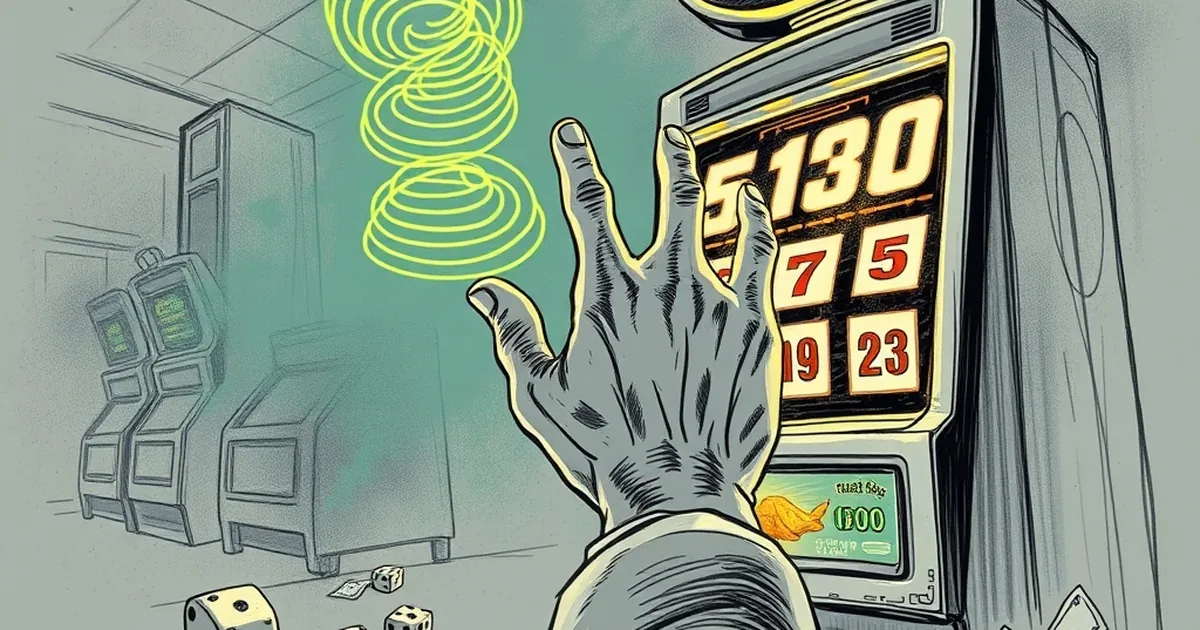
The count-up ticker on a progressive jackpot slot isn’t passive decoration. It’s a behavioral nudge that exploits a quirk in how we perceive time and money. By showing the pot grow in real time, the casino is effectively training you to frame every spin as a recovery attempt, not a wager.
The Psychology of the "Almost"
The core issue isn't the jackpot amount. It’s the rate of change. When a ticker sits at $1,247,331 and climbs $0.17 every second, your brain doesn't register a static prize. It registers a moving target you're missing out on. This is the "near-miss" effect on a macro scale.
A standard slot near-miss is two matching symbols with the third one pixel off. The ticker is a continuous near-miss. You look up, the number is higher than when you last glanced. You feel like you've already "lost" that incremental increase by not spinning. The only way to catch up to that perceived loss is to play faster.
The Anchoring Problem
We know from behavioral economics that people anchor to the first number they see. If you sit down at a machine and the ticker reads $2,100,000, that's your baseline. When it hits $2,100,040, you don’t think "I'm up $40 in theoretical value." You think "I'm behind, because I didn't win it."
This flips the emotional ledger. A jackpot hit becomes a matter of clawing back a debt you never owed. The count-up converts a long-shot lottery ticket into a refund claim. That's a critical shift. You stop evaluating the spin’s RTP and start evaluating how close the ticker is to a round number.
The "Round Number" Trap
Here’s a concrete stat to chew on: over 70% of progressive jackpot wins occur within 3% of a $100,000 or $1,000,000 milestone. That number isn’t official—casinos don't publish that data—but it's a reasonable inference from how players cluster their play.
Think about it. You see $1,998,500. You know it’s going to hit $2M in about 15 minutes at the current rate. You tell yourself you'll stop at $2M. Then it hits $2M, and you don't stop, because now you've "invested" 15 minutes of watching it climb. The count-up creates a false sense of a scheduled event. It feels like the machine is building toward a payout, not randomly sampling a random number generator.
The Disconnect From Bankroll Reality
When you play a normal slot, you track your own balance. With a count-up jackpot, you track the machine's balance. This is a critical distraction. A player who is down $150 but watching a ticker climb to $4.2M stops thinking about their own burn rate.
The ticker effectively outsources your bankroll management to a ceiling that doesn't exist. You're not chasing your own losses; you're chasing the ticker's gains. That's worse. Your loss limit is finite. The ticker is infinite until it's hit. So you play longer, because the "event" hasn't happened yet.
The Real Question
The count-up doesn't make the jackpot more likely to hit. It doesn't change the odds. It changes your perception of when you should quit. If the ticker froze at a static number, you'd assess the odds once and move on. The count-up forces you to reassess every few seconds, and every reassessment feels like a missed opportunity.
So the question isn't whether you'll hit the jackpot. It's whether you'd have stopped playing an hour ago if the machine didn't keep telling you it was getting closer to something.
— creative mess